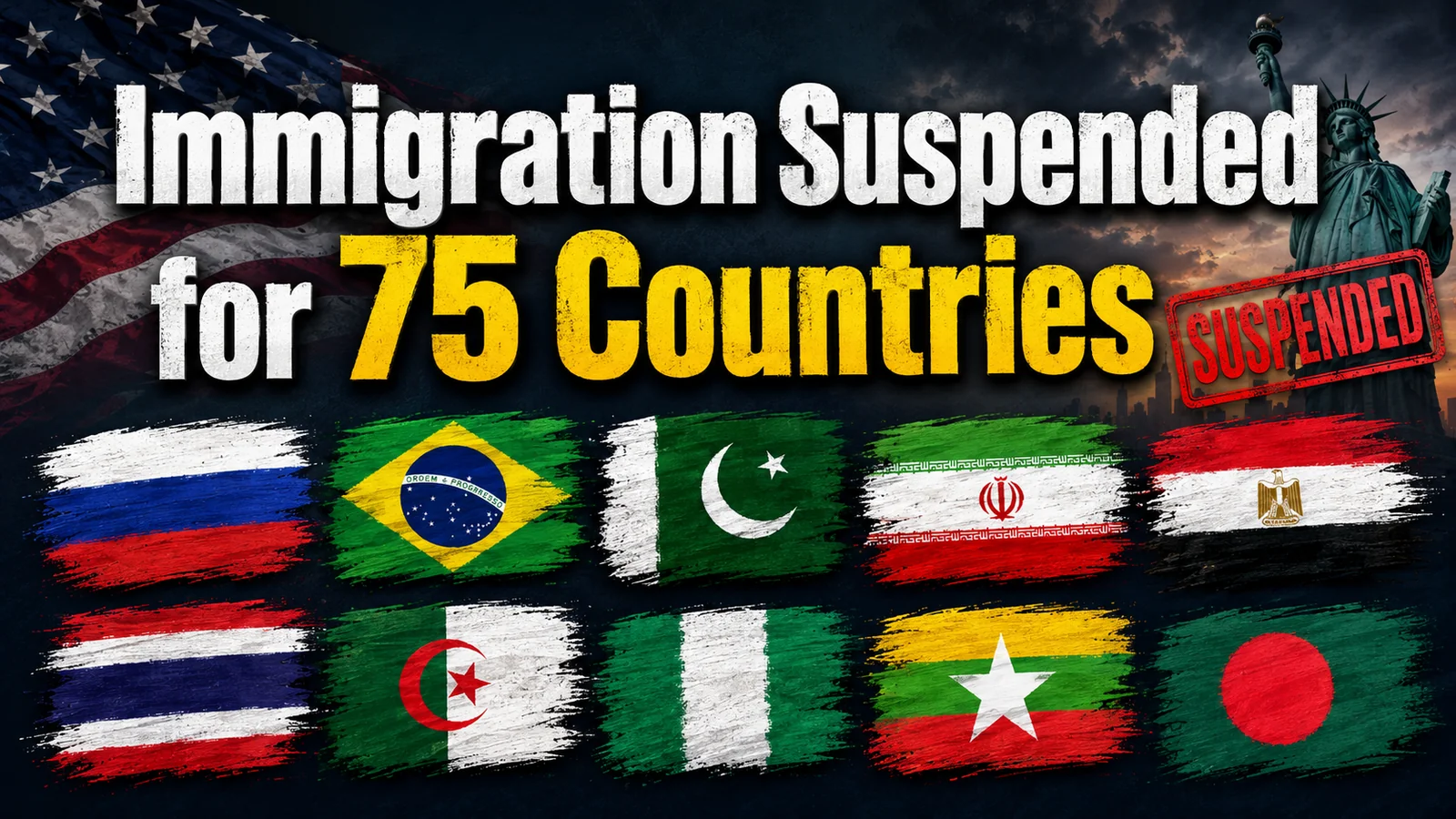
On January 14, 2026, the US State Department announced an immigrant visa suspension affecting nationals of 75 countries, beginning January 21, 2026. In plain terms: if you are from one of these countries and applying to move to the United States permanently, your visa is now frozen — even if you were close to approval. The government says the pause targets applicants it believes are likely to rely on public benefits, a policy it calls the “public charge” rule. The suspension is indefinite, with no announced end date.
What the Immigrant Visa Suspension Actually Does
Think of a US visa application like a long race. You file forms, get sponsored by a family member or employer, attend interviews, and finally — at the finish line — a US embassy prints and hands you your visa.
This rule stops people right at the finish line. Applicants can still submit forms and, in many cases, attend interviews, but consular officers have been told not to approve or issue the final visa. Some people who were already approved but had not yet received their printed visa are now stuck as well.
So the system is technically still “open,” but nothing comes out the other end. There is no deadline for when the pause might lift.
What It Does NOT Affect
This is the part that confuses most people. The pause is only for immigrant visas — the kind for people who want to live in the US permanently (the green-card track, through family or employer sponsorship).
It does NOT affect:
- Tourist visas (vacation visits)
- Business visas (short work trips)
- Student visas
- Temporary work visas such as H-1B, L-1, O-1, and E visas
- People already inside the US who are adjusting their status through USCIS
This matters because the US is co-hosting the 2026 FIFA World Cup and the 2028 Olympics, and officials wanted to keep visitor travel open.
The Dual-National Exception
There is one important workaround. If you hold dual nationality, you may still be able to apply using a valid passport from a country that is NOT on the suspension list. So someone who is a citizen of both an affected country and an unaffected one is not necessarily blocked.
Why the Government Says It’s Doing This
The official reasoning is that people from these countries are, in the administration’s words, at high risk of becoming a “public charge” — relying on taxpayer-funded benefits after they arrive.
Officials framed the move as part of a broader “full review” of how the US screens and vets visa applicants, with a focus on financial self-sufficiency. It builds on a November 2025 directive and on earlier restrictions that had already paused visas for places like Brazil, Iran, Russia, and Somalia.
Who Gets Hurt
- Families waiting to reunite with relatives already in the US
- Workers who spent years in the green-card process and are now stranded abroad
- Employers who recruited international talent expecting them to relocate
Roughly 38% of all countries in the world are on this list, so the reach is wide.
The Bigger Picture
This suspension is one piece of a much larger 2025–26 tightening of US immigration. Over the same period, the administration imposed a travel ban on a group of countries and later expanded it, set a record-low refugee admissions cap of 7,500 for fiscal 2026, and sharply raised the H-1B skilled-worker visa fee to $100,000 per application. According to a Brookings Institution analysis, more immigrants left the US than entered in 2025 — the first net-negative immigration year in roughly five decades.
The Full List: 75 Countries (Alphabetical)
- Afghanistan
- Albania
- Algeria
- Antigua and Barbuda
- Armenia
- Azerbaijan
- Bahamas
- Bangladesh
- Barbados
- Belarus
- Belize
- Bhutan
- Bosnia and Herzegovina
- Brazil
- Burma (Myanmar)
- Cambodia
- Cameroon
- Cape Verde
- Colombia
- Cote d’Ivoire (Ivory Coast)
- Cuba
- Democratic Republic of the Congo
- Dominica
- Egypt
- Eritrea
- Ethiopia
- Fiji
- The Gambia
- Georgia
- Ghana
- Grenada
- Guatemala
- Guinea
- Haiti
- Iran
- Iraq
- Jamaica
- Jordan
- Kazakhstan
- Kosovo
- Kuwait
- Kyrgyz Republic (Kyrgyzstan)
- Laos
- Lebanon
- Liberia
- Libya
- Moldova
- Mongolia
- Montenegro
- Morocco
- Nepal
- Nicaragua
- Nigeria
- North Macedonia
- Pakistan
- Republic of the Congo
- Russia
- Rwanda
- Saint Kitts and Nevis
- Saint Lucia
- Saint Vincent and the Grenadines
- Senegal
- Sierra Leone
- Somalia
- South Sudan
- Sudan
- Syria
- Tanzania
- Thailand
- Togo
- Tunisia
- Uganda
- Uruguay
- Uzbekistan
- Yemen
Bottom Line
If you or someone you know is from one of these 75 countries and is in the middle of a permanent immigration process through a US embassy abroad, the safest move is to talk to an immigration attorney before making travel or job decisions. With no end date set, timelines are now genuinely uncertain.
Sources
- Reuters — “Trump administration to suspend immigrant visa processing for 75 nations” (Jan 14, 2026)
- Al Jazeera — “Trump suspends immigrant visas for 75 countries: Who’s affected?” (Jan 15, 2026)
- The Washington Post — “Trump administration indefinitely pauses immigrant visa processing for 75 nations” (Jan 14, 2026)
- Fisher Phillips LLP — full country list (Jan 16, 2026)
- US State Department — official immigrant visa updates page
This post is for general information only and is not legal advice. For guidance on a specific situation, consult a qualified immigration attorney.